What genetic progress has been made in peas in recent years?
Genetic progress in yield potential, measured in registration and post-registration trials managed by Geves and Terres Inovia, is estimated at 0.067 t/ha/year for spring peas and 0.054 t/ha/year for winter peas (van Boxsom & Retailleau, 2022). Furthermore, very significant progress has been achieved on lodging resistance, frost resistance of winter peas, and very recently, the first spring pea varieties showing partial tolerance to root rot caused by Aphanomyces have been registered. However, this genetic progress has been notoriously insufficient to maintain yields in farm fields, due to the crop's sensitivity to climatic hazards and to many pests for which no tolerant varieties are yet available on the market.
What is the main objective to unlock pea cultivation?
The sector diagnosis by the interprofessional body Terres Univia (filiere-pois-2022.pdf) clearly indicates that the limiting factor today is the ability to produce more volumes, which downstream players are waiting for. To achieve this, the economic analyses of Terres Univia and the technical institute Terres Inovia (pointeco-2024-11) show that a gain of 1 t/ha in yield needs to be recovered at the national scale. Such a gain would bring pea cultivation back to a level of economic performance similar to other major crops. The combination of accelerated genetic progress across all criteria including yield potential, and the integration of resistance to multiple stresses, should make it possible to recover these yield levels, which were regularly achieved two decades ago.
Where can I find information about the pea sector and its cultivation?
Reference information can be obtained from the interprofessional body Terres Univia and the technical institute Terres Inovia. We particularly recommend the growing guide for all technical information on crop management. Indeed, to express their full potential, varieties need careful crop management, as with all species!
Where can I find information about current varieties?
The most practical tool for consulting technical information on varieties is myvar, developed by Terres Inovia. It compiles information from registration and post-registration trials on the varieties being distributed. If you want information on the catalogue of registered varieties, you can find it on the Geves website.
Is it possible to collaborate on the Pea4Ever programme?
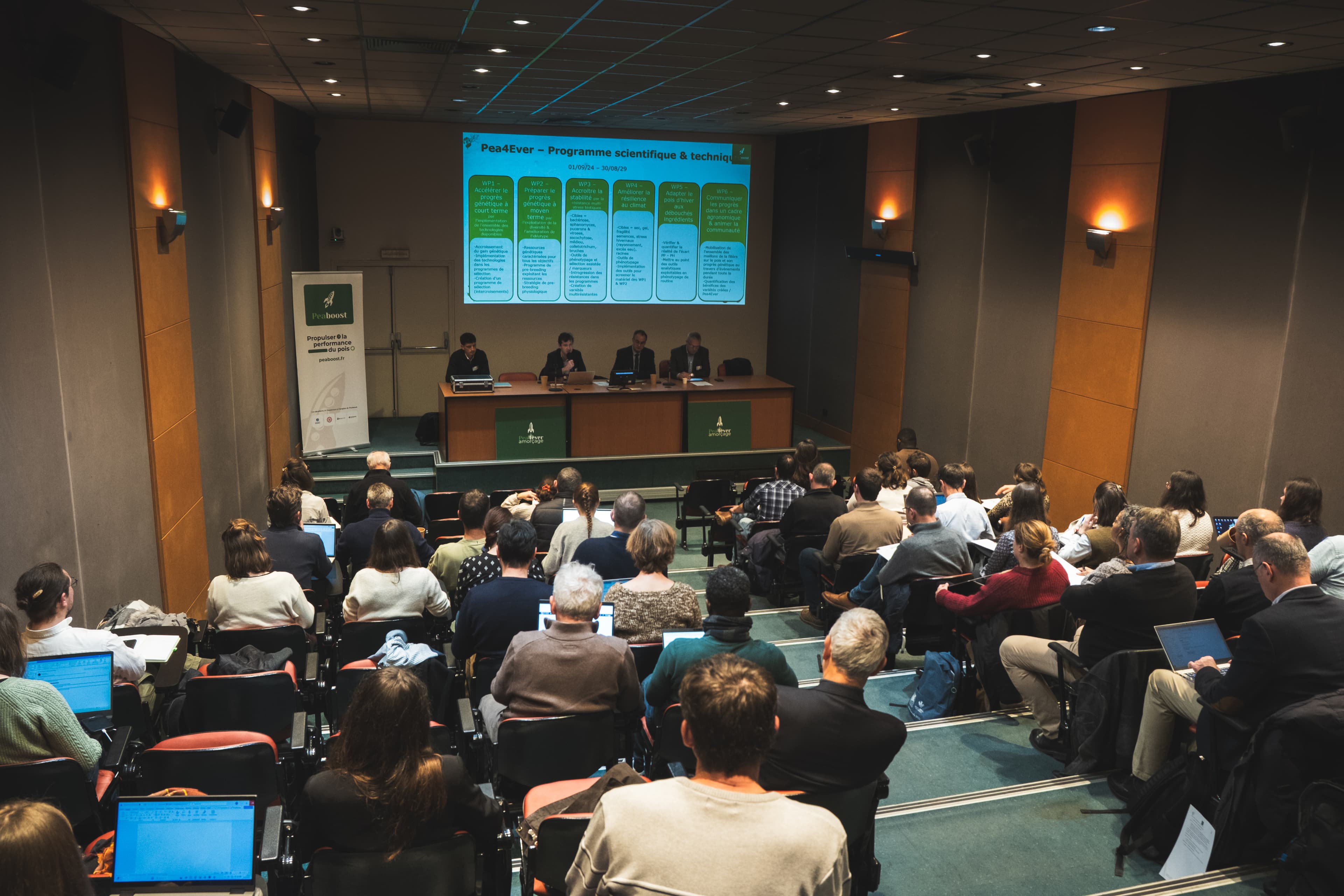
To address all the improvement targets for peas, scientific and technical collaborations are essential. We have already brought together partners for our first actions, but remain open to opportunities to work with teams, both academic and private, who are interested. Do not hesitate to contact our team by email.
How do you go about accelerating genetic progress?
To successfully combine all favourable characteristics in a variety, a large number of crosses must be made and the maximum number of descendants produced: this is primarily a question of resources, made possible by the funding obtained for varietal research. Then, collaboration between PeaBoost member companies allows them to recombine their best genetics without waiting for them to be registered. Next, speed breeding techniques allow the first generations to be completed more than twice as fast. Finally, reliable selection methods are needed: the use of genomic prediction, digital drone phenotyping, and the development of multiple pest resistance testing protocols improves selection reliability and absorbs the increase in the number of individuals to be tested.
 Contact